Series 37 - The Civilization of Nusantara 1
Before Mesopotamia:
The Civilization the Sea Swallowed
What if the oldest chapter of human civilization is not buried in the sands of Iraq — but beneath the waters of Southeast Asia?
Every schoolchild is taught the same story. Civilization began around 3,500 BCE in Mesopotamia — the fertile crescent between the Tigris and Euphrates rivers, in what is today Iraq. Writing, cities, agriculture, law — all of it, we are told, started there. The rest of the world followed.
It is a tidy story. It is also almost certainly incomplete — and the evidence accumulating from the Nusantara archipelago suggests it may be wrong in ways that matter enormously.
Because beneath the waters of Southeast Asia, on the floors of the Java Sea and the Strait of Malacca, lies a sunken continent. Its name is Sundaland. And it may hold the ruins of a civilization that predates Mesopotamia by thousands of years.

A Continent Swallowed by the Sea
During the last glacial maximum, sea levels across the globe were approximately 120 metres lower than today. What is now the floor of the Java Sea, the Strait of Malacca, and the Gulf of Thailand was dry land — lush, volcanic, equatorial terrain, watered by great rivers and sheltered from the open ocean.
This was Sundaland. It connected what we today call Borneo, Java, Sumatra, and the Malay Peninsula into a single, enormous landmass — roughly the size of modern India. For tens of thousands of years, it would have been among the most hospitable places on Earth for human settlement: warm, fertile, and rich with freshwater.
Then the ice age ended. In three massive pulses — around 14,000, 11,500, and 7,600 years ago — the seas rose and consumed it. Rivers became straits. Hills became islands. An entire world went underwater.
Any civilization that had developed on Sundaland left its ruins on the seafloor. Its people became refugees, carrying their knowledge inland and across the archipelago. Their calendar, their cosmology, their language — encoded in whatever could survive the flood.
A civilization does not disappear when its cities sink. It disappears when its people stop remembering. And the people of Nusantara never stopped remembering.
The Calendar That Has No Beginning
Here is a question worth sitting with: how do you prove that a civilization existed if its monuments are under 60 metres of seawater?
You look for what it left behind on dry land. And in Nusantara, the most extraordinary survival is not a temple or a statue or a manuscript. It is a calendar. Specifically — the Pawukon.

The Pawukon is a 210-day cycle consisting of ten different "weeks" of 1 through 10 days, all running simultaneously. Every day is defined by its position across all ten cycles at once — creating a unique combination that will not repeat for 210 days. And then it simply begins again.
What makes the Pawukon extraordinary is not its mathematics, elegant as that is. It is its philosophy. The Pawukon has no epoch — no year zero, no origin date, no starting point. It does not count years at all. It simply cycles. Endlessly. Without beginning and without end.
Every other ancient civilization that developed calendar systems eventually asked the same question: When did time begin? Mesopotamia assigned a creation date. Egypt marked its dynastic origins. The Maya calculated all the way back to a cosmic moment of creation. Hindu tradition assigned Yuga origins.
Nusantara's answer was categorically different. Time did not begin. It cycles. Always has. Always will.
This is not a gap in the historical record. It is a deliberate philosophical statement — one that implies the civilization had been observing cycles long enough to stop believing in starting points.
The Pawukon — Key Facts
- OriginJava — predating Bali's preservation of the system after the fall of Majapahit
- StructureTen concurrent weeks of 1–10 days; 210-day full cycle (LCM of 5 × 6 × 7)
- PhilosophyNo epoch, no year count — pure cyclical time with no beginning or end
- Oldest evidenceInscriptional references from 8th century CE; structural origins assessed as pre-Hindu
- 210 daysEquals 30 weeks of human pregnancy, 7 lunar months, and fits Java's dual rice harvest cycle
- TodayStill actively used in Bali for religious ceremony and spiritual life
74,000 Years Ago: The Sky Watchers of Toba
Now the story becomes even older — and stranger.
Approximately 74,000 years ago, the Toba supervolcano in northern Sumatra erupted in the single most violent geological event since modern humans evolved. It blasted an estimated 5,000 cubic kilometres of magma into the atmosphere. The sky darkened across the globe. Temperatures dropped. Genetic evidence suggests the entire human population was reduced to perhaps 3,000 to 10,000 surviving individuals — the closest our species has ever come to extinction.

The people who survived Toba in Sumatra became the ancestors of the Batak. And the Batak carry a calendar tradition that may preserve the memory of that catastrophe in the stars themselves.
The ancient Batak calendar — the Porhalaan — marks its New Year at the moment when the constellation Orion slips below the western horizon and Scorpius rises in the east. On the last moonless night in May, the Batak datu (shaman-priest) would watch this precise celestial transition and declare: the new year has begun.
Like the Pawukon, the Batak calendar has no year number. No epoch. It simply restarts when Orion yields to Scorpius. A survivor standing on the ash-covered slopes of Toba 70,000 years ago, watching the first night that the stars returned after the volcanic darkness — watching Scorpius climb the eastern sky for the first time since the catastrophe — would have had a profound reason to mark that exact moment forever. The Batak New Year, anchored to precisely this astronomical event, may be a memory encoded across 70,000 years of human time.
You cannot accidentally stumble upon the Orion-Scorpius opposition cycle. Tracking it requires multi-generational observation, fixed observational points, institutional memory, and a symbolic system to transmit the knowledge. This is, by definition, civilizational behaviour.
The God in the Language: Kapitayan
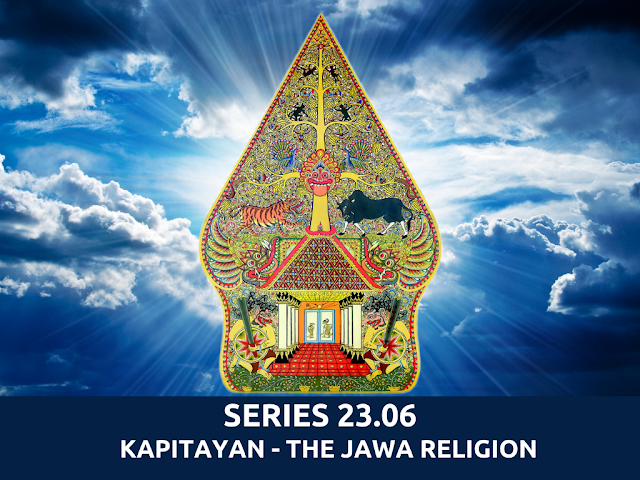
Before Hinduism arrived in Java. Before Buddhism. Before Islam. There was Kapitayan.
Kapitayan is the oldest documented belief system of Java — a monotheistic religion whose central concept is Sanghyang Taya: the Absolute, defined entirely by what it is not. Taya cannot be seen. Cannot be imagined. Cannot be approached by the five senses. It is God as pure void — a concept of striking philosophical sophistication that parallels Taoist emptiness and Islamic tawhid, arrived at independently and possibly millennia earlier.


The evidence for Kapitayan's extraordinary depth lies hidden in plain sight — in the Indonesian language itself. The Kapitayan system held that divine power, called Tu or To, was hidden in all things bearing those syllables: wa-tu (stone), tu-gu (pillar), tu-lup (blowpipe), to-peng (mask). The entire pre-Hindu Javanese linguistic landscape was organized around a divine naming convention.
And here is the remarkable consequence: the word Tuhan — meaning "God" in Indonesian and Javanese, used by every Muslim, Christian, Hindu, and Buddhist in the country — comes directly from the Kapitayan root. Every time an Indonesian says the word for God, in any religion, they are speaking the language of a faith that predates all of those religions by centuries or millennia. That is a civilization that never truly died.
Indonesia Taught Tibet How to Be Buddhist
This is perhaps the most astonishing fact of all — and it is not contested. It is confirmed by the Dalai Lama himself, on his official website, in his own words.
In the early 11th century CE, the Indian Buddhist master Atisha — considered one of the most important figures in the transmission of Buddhism to Tibet — made a thirteen-month sea voyage to Sumatra. He came to study with a master called Dharmakirti, known to Tibetans as Lama Serlingpa, "Master of the Golden Isle." Dharmakirti was a Srivijayan prince, born in Sumatra, and at that moment in history he was the sole holder of the complete Bodhichitta lineage on Earth. There was nowhere else Atisha could go.


Atisha spent twelve years in Sumatra. When he finally left for Tibet, he carried a small gold reliquary containing Dharmakirti's bodily remains — a gesture of devotion he maintained for the rest of his life. He said: "The reason I have a kind heart is due to Serlingpa's kindness."
Atisha's teaching in Tibet gave rise to the Lamrim tradition, which shaped the Gelug school, which produced the lineage of the Dalai Lamas. Every Tibetan Buddhist today — every practitioner of Lojong mind-training, every student of the stages of the path — is following a lineage whose most critical link was a Srivijayan prince from Sumatra.
The colophon preserved in the Tibetan Tengyur — the canonical collection of Buddhist commentaries, kept intact for over a thousand years — names Dharmakirti explicitly, writing for a Srivijayan king, in Sumatra. This is not mythology. It is a documented, canonical historical record.
What the Conventional Narrative Gets Wrong
The standard history of civilization places its origin in Mesopotamia around 3,500 BCE. That narrative describes not the origin of civilization — but the most recent reconstruction of it, after earlier civilizations were lost beneath the sea.
The Nusantara evidence, taken seriously and followed rigorously, tells a different story: a civilization that emerged before recorded history, survived the Toba supervolcano, built observatories and temple complexes, developed a calendar of profound mathematical and philosophical elegance, encoded its understanding of God in the very syllables of its language, and transmitted the most essential lineage of Tibetan Buddhism to the world.
It did not do this by being primitive. It did not do this by receiving culture from elsewhere and passing it on. It originated. It created. It survived catastrophe after catastrophe — the volcano, the flood, the Hindu overlay, the spread of Islam, Dutch colonialism, and modern globalization — and it is still here.
The Pawukon wheel still turns in Bali. The word Tuhan is still on every Indonesian's lips. The gold reliquary Atisha carried from Sumatra to Tibet changed the course of Buddhist civilization. The proof of what Nusantara was lies in three places still largely unexplored: the underwater ruins of Sundaland, the deep stratigraphy beneath Gunung Padang, and the oral traditions of the indigenous peoples who remember.
The chapter of human history stored in Nusantara has barely been opened.

Comments
Post a Comment