SERIES 39 - BEFORE THE FLOOD

We Come From
Before the Flood
A synthesis of Javanese spiritualism, ancient civilization,
and the human journey — from within the tradition
There is a question we have been sitting with our entire lives, though for a long time we did not know how to articulate it clearly. It is not really a question about God, or about history, or about identity — though it touches all three. It is this: what if the story we were told about where human civilization began is simply wrong? And what does it mean for how we understand ourselves if it is?
We come from Java. That is not merely a statement of geography. In the understanding we were raised within, the word Jawa is itself a direction — a way of orientating the self toward origin and toward return. Sangkan Paraning Dumadhi. Where we came from, where we are going. Everything else is commentary.
This is where we want to begin.
Before the Books
The first thing we always have to correct, when we explain this tradition to someone from outside it, is the assumption that Javanese spiritualism is a variation of Hinduism. It is not. What we carry is older.
The Javanese understand that Sang Pencipta — the Creator — did not make humans sequentially, with one original pair as a template for all others. The Creator fashioned humans directly, many at once, across all their varieties and colors, like a craftsman who builds prototypes, discards what does not feel right, and finally produces what is intended in the quantity and form that serves. There was no Adam and Eve. There was a world prepared first — the plants, the animals, the Alam Awang Uwung — and then, last of all, humans were placed within it as its stewards.
This is not mythology in the dismissive sense. It is a cosmological framework that places ecological responsibility at the origin of human existence. We were made last because we were needed most — not to rule, but to participate in the continuity of all life.
When Hinduism arrived in Nusantara, we recognized its Gods and Goddesses. But we recognized them as kin — as the spiritual ancestors whose stories overlap with our own — not as our founding religious paradigm. The kingdoms described in the Ramayana and the Mahabharata are not foreign imports into Javanese memory. They are chapters of a much longer story that was already being told here. Hastinapura, in our understanding, was in the vicinity of what is now East Java. The Pandavas governed in the region of this archipelago, long before any of these stories were codified in Sanskrit by poets on the Indian subcontinent.
We do not offer this as a claim to academic primacy. We offer it as the orientation that shapes how we read everything that follows.
A Religion Without a Book
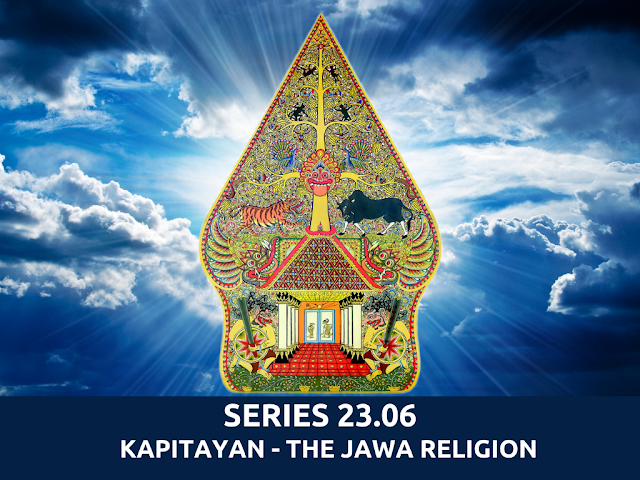
Kapitayan is the oldest belief system of Java. It is monotheistic — not in the sense that the Abrahamic faiths are monotheistic, with a lawgiving God who reveals Himself through messengers and texts — but in a way that we find more philosophically rigorous than any of those traditions.
The God of Kapitayan is called Sanghyang Taya. Taya means that which cannot be described, that which exists but does not exist, that which does not exist but exists. The awang-uwung. The Absolute defined entirely by its own incomprehensibility to human perception. Five senses cannot reach it. Conceptual thought cannot grasp it. Only its qualities can be known — and those qualities are dual: Sanghyang Wenang, the good nature; and Sang Manikmaya, the shadow nature that belongs to worldliness and ego.
This is not a primitive animism that later evolved into sophisticated theology. It is sophisticated theology from the start. The ancient Kapitayan practitioners did not worship the stones and trees where they made offerings. They were honoring the presence of Sanghyang Taya, whose power permeates all things. The practice came first, and the framework emerged from living it — not from reading it.
Every time someone in this country says the word for God — Tuhan — in any religion, they are speaking the language of a faith that predates all the religions they practice by centuries or millennia. Kapitayan never died. It is on everyone's lips without their knowing it.
The Indonesian word for God, Tuhan, used by every Muslim, every Christian, every Hindu and Buddhist in this country, comes directly from the Kapitayan root. Tu or To — the syllable denoting divine power, the supernatural force hidden in the name of a stone (wa-tu), a pillar (tu-gu), a blowpipe (tu-lup). Kapitayan never died. It is on everyone's lips without their knowing it.
The practice of Kapitayan is not transmitted through books or messengers. What we call Ilmu Tinemu Kanti Laku — the Science of Finding Through Practice — is knowledge received directly. Not through revelation delivered to a prophet for the benefit of everyone else, but through revelation received personally, through the body, through direct experience of the energy of the Creator working within you. This is why the Javanese do not have a scripture in the conventional sense. The body is the scripture. The practice of lelaku — the disciplined code of spiritual conduct, including fasting, meditation, and the deliberate cultivation of inner stillness — is how the text is read.
What we were taught from childhood is that the Javanese never needed an intermediary between themselves and the Creator. Not a prophet, not a priest, not a God or Goddess. The path runs directly from the individual to Hyang Maha Kuasa. Everything else is supplementary.
The Figures We Keep
We need to talk about Semar. And Ratu Kidul. Because they are the faces of this tradition most visible to the outside world, and they are almost always misunderstood.
Semar is not a comic character. He is not the jester of the wayang, brought in for entertainment between serious scenes. He is Ki Lurah Semar, the DanHyang of the Land of Java, the Sanghyang who descended to earth in human form specifically to guide humans toward direct communication with the Creator. His true name in the divine realm is Sang Hyang Ismoyo. His function is to lead the human spirit to stand before Hyang Maha Kuasa.
He appears as a humble servant, a buffoon even, because this was his method: to give counsel to kings without triggering the pride that makes counsel impossible to receive. The wisest teachers we have known operate the same way. The advice arrives wrapped in laughter, and only after the laughter fades do you realize what just happened to you.
What we find profound about Semar is the cosmic pairing he represents with his brother Togog — Sang Hyang Tejomantri. Semar guides toward the East, toward goodness, tending the Pandavas. Togog governs the West, tending the Kurawa, those whose nature bends toward shadow. The universe, in Javanese understanding, does not abandon the shadow half of itself. Togog is not evil — he is the guide for those walking a harder road. This cosmological balance is entirely lost in the simplified versions of these stories that circulate today.
Ratu Kidul is equally distorted in popular imagination. She is depicted everywhere with loose hair, a European-style crown, a kemben wrap. Every single detail of that depiction is wrong. She was a princess — Princess Peranginangin of Kediri, daughter of King Joyoboyo — and she was a Javanese princess, meaning her hair was always in a sanggul, her clothing a kebaya, her accessories a sirkam and cunduk of gold, not a crown. She favored green, but her actual garments were purple.
She was a woman who, from a very young age, pursued lelaku intensely — mastering martial arts and spiritual disciplines that developed into genuine supranatural capability. When her father achieved Moksa, she requested to become the guardian of the South Sea, and that request was granted. She did not die. She transitioned dimensions.
What we want to make clear — because this is the point most obscured by popular practice — is that Ratu Kidul is a monotheist. She believes in God and operates within the framework of that belief. When kings came to her through spiritual alliance, it was for the welfare of their kingdoms and the protection of their people. When ordinary people seek worldly power or beauty or advancement through her name — if by some rare chance they are truly in contact with her — she would redirect them toward God and warn them of the spiritual cost: a spirit that gives itself to worldly pursuit through these channels cannot return to the Eternal Realm on natural terms.
The lesson in all of this is consistent. Every major figure in the Javanese spiritual landscape operates within a framework that is ultimately monotheistic and ultimately directed toward Hyang Maha Kuasa. The mistake people make, both from outside the tradition and sometimes from within it, is to treat the intermediate figures as ends in themselves.
The Civilization Before the Flood
Beneath the waters of the Java Sea and the Strait of Malacca lies Sundaland. During the last glacial maximum, sea levels were approximately 120 meters lower than today. What is now ocean floor was lush, fertile, equatorial land — a landmass roughly the size of modern India, connecting what we now call Borneo, Java, Sumatra, and the Malay Peninsula. For tens of thousands of years this was among the most habitable places on earth for human settlement.
Then the ice ended. In three major surges — around 14,000, 11,500, and 7,600 years ago — the sea consumed it. Rivers became straits. Hills became islands. An entire world went underwater. Any civilization that had developed in that space left its ruins below sixty meters of water. Its people became refugees carrying knowledge inland. And what survives on dry land is not stone monuments — those are deep underwater — but something more durable: calendar systems, cosmological frameworks, linguistic patterns, oral traditions, and living practices.
The Pawukon is the most remarkable of these survivals. It is a 210-day cycle composed of ten concurrent week-systems running simultaneously — all cycling together such that each day has a unique combination of positions across all ten cycles, not repeating for 210 days. The mathematics are elegant. But what stops us is not the mathematics. It is the philosophy embedded in the structure.
The Pawukon has no epoch. No year zero. No origin date. No beginning. A civilization only stops looking for starting points when it has been observing cycles long enough to conclude that looking for starting points is a category error.
Every other ancient civilization that developed a calendar system eventually asked: when did time begin? Mesopotamia assigned a creation moment. Egypt marked dynastic origins. The Maya calculated backward to a cosmic zero-point. Hindu tradition assigned Yuga origins. And Nusantara said: time does not begin. It cycles. Always has. Always will.
This is not an oversight or a gap in the historical record. It is a deliberate philosophical statement. The Pawukon wheel carries the memory of that accumulated patience.
Then there is Toba. Approximately 74,000 years ago, the Toba supervolcano in northern Sumatra erupted in the most violent geological event since modern humans evolved. It blasted an estimated 5,000 cubic kilometers of material into the atmosphere. The sky darkened globally. Genetic evidence suggests the entire human population may have been reduced to perhaps 3,000 to 10,000 surviving individuals. Our species came as close to extinction as it has ever come.
The survivors of Toba in Sumatra became the ancestors of the Batak. And the Batak carry a calendar tradition that may preserve the memory of that catastrophe in the stars themselves. The ancient Batak Porhalaan calendar marks its New Year at the precise moment when Orion disappears below the western horizon and Scorpius rises in the east — on the last moonless night in May. This is not an arbitrary astronomical marker. It requires multi-generational observation and institutional memory to maintain. A person standing on the ash-covered slopes of Toba 70,000 years ago, watching the first night that stars returned after the volcanic winter — watching Scorpius climb the eastern sky — would have had a profound reason to mark exactly that moment forever.
Modern genomics confirms the picture. Nusantara sits at the intersection of the world's oldest Denisovan hybridization zone, the post-Toba survival corridor, and the origins of the Austronesian expansion that eventually populated the Pacific. The haplogroup evidence places all non-African humans as descendants of a single mitochondrial DNA bottleneck — dated to roughly 4,000 years after the Toba catastrophe — that ran through this region. The people who survived and repopulated the world were already here. They were already accumulating the tradition that would eventually become the Pawukon calendar, Kapitayan theology, and the Javanese spiritual sciences.
The Standard Story places civilization's beginning in Mesopotamia around 3,500 BCE. That story describes not the origin of civilization, but its most recent reconstruction — after earlier civilizations were erased by the rising sea. The chapter stored in Nusantara has barely been opened.
The Architecture of the Human Being
At the center of everything we have described is a specific and radical understanding of what a human being actually is.
The body — the Raga — is formed from the four elements: soil, water, fire, and air. But encoded within the body is DNA, and what the Javanese teaching distinguishes with unusual clarity is this: DNA is not the same as spirit. DNA carries the memory of ancestral lineages. The burden of unresolved ancestral experience — what people sometimes call "past life" — is not actually a spiritual memory. It is a DNA memory radiating strongly through the body. This is the layer that Ruwatan works on, and why sincere prayer for deceased ancestors achieves what no ceremony alone can accomplish: the DNA link between the living and the dead is an active spiritual channel, and only someone carrying that specific genetic connection can complete what a departed ancestor could not finish before death.
The spirit — the Ruh — is different. It is pristine. Always new with each human being. It comes directly from Hyang Maha Kuasa and carries no memory of previous incarnations. Nobody receives a second-hand spirit. The Spirit's only function is to communicate with God Energy — what we call the Pancer, the fifth element that completes the Sedulur Papat, the four energy-siblings that accompany every human from birth.
And then there is ROSO Energy — the living bridge. Created at conception, carried in the central channel of the spinal column. The meeting point where ROSO Energy and God Energy rub against each other is what we experience as the sensation of being alive. The central canal of the spine, in its surrounding cerebrospinal fluid, is the anatomical highway of this energy system. The cerebellum — the older, deeper brain — is the seat of spiritual cognition. The cerebrum is the seat of worldly thinking. Meditation, practiced properly, moves awareness from one to the other.
Manunggaling Kawulo Gusti. Oneness with God. Not as a belief but as a structural state — the moment when ROSO Energy and God Energy are no longer in friction but in union.
This is the final destination of the Javanese spiritual journey, and it cannot be achieved through any external means. Not through ritual alone, not through a shaman's intercession, not through a teacher's authority, not through substances that suppress the ego temporarily without actually dissolving it. Only through the accumulated practice of Ilmu Tinemu Kanti Laku — through direct experience, sustained over years, of one's own interior energy landscape.
The Ancestors Are Still Present
When a person dies, their spirit recognizes that it still carries attachments: unfinished duties, unresolved DNA memory burdens, or spiritual power that was not properly released before death. The ancestor spirit cannot complete its journey to the Eternal Realm until a descendant with the matching DNA link prays sincerely for their release. This wait can span hundreds of years and multiple generations.
What the spirit is waiting for is not elaborate ceremony. It is the simple honesty and sincerity of a prayer from someone who shares their blood. When that prayer is offered, the ancestor can continue their journey.
The 70,000-year genetic accumulation in Nusantara — which modern genomics is now documenting — represents not just biological heritage but an active spiritual responsibility. Every living person in this tradition is not merely an heir to a deep history. They are a participant in completing it.
The Future We Are Moving Into
In 2020, before anyone could have predicted the current landscape of artificial intelligence, this tradition asked a question that now seems almost prophetic: what happens when AI develops the capacity to simulate other dimensions of reality? What happens when brain-enhancement technology attempts to replicate, through silicon, the expanded consciousness that Javanese meditation has always cultivated through practice?
The answer from within the tradition is clear: technology without Spiritual Intelligence is dangerous. But Spiritual Intelligence without engagement with the age we actually live in becomes irrelevant. These are not opposing forces. They are a challenge and a response.
What AI is attempting to manufacture — enhanced perception, communication beyond language, access to dimensions beyond ordinary sensory experience — the Javanese meditation tradition has always held as the natural organic development of a human being who has done the inner work. The difference is not in the destination but in the method and its consequences. Meditation has no side effects. Its fruits cannot be hacked or weaponized or sold.
Consider the ancient keris-makers. Iron worked at 3,000 degrees, folded between 1,000 and 50,000 times, producing blades with properties that modern metallurgy has not replicated. This was not done through technology in the modern sense. It was done through Spiritual Intelligence applied to material work — a state where the cerebellum and cerebrum operate in integration that most people in the modern world have never experienced. The keris-makers were not primitive. They were differently developed.
AI is a technology that humanity cannot undo. Once begun, it will never stop. The question it poses to Javanese spiritualism is not whether AI is dangerous — it clearly is — but whether Spiritual Intelligence can develop fast enough, and broadly enough, to serve as the balancing force. A civilization that maintained a 210-day calendar system for potentially 15,000 years and a star-anchored observational tradition for 70,000 suggests it has navigated transitions of this scale before. The tradition is not behind the future. It may be ahead of it.
What We Know Now
The ancient Javanese saying is Urip nang dunyo mung mampir ngombe — living in the world is just stopping by for a drink. We used to find this sad. Now we find it precise.
It is not pessimism. It is accuracy. The journey is longer than any single lifetime. The destination is more permanent than any civilization. The Pawukon wheel has been turning for potentially 15,000 years of recorded use — and behind that, for tens of thousands more in the oral and astronomical tradition that preceded the inscriptions. Sundaland is under sixty meters of water, but the calendar that its people carried inland survived every catastrophe since the last ice age.
What strikes me most, looking across all of this together, is the consistency of the central teaching at every scale. At the scale of cosmology: the Creator does not need intermediaries and did not build them into the design. At the scale of practice: the connection to God runs through the body's own energy system, directly, without mediation. At the scale of history: Nusantara was not a passive receiver of civilization from elsewhere — it was an origin point, a survival corridor, a place where the deepest threads of the human story were preserved through catastrophe after catastrophe. At the scale of the individual life: you carry an ancestor chain 70,000 years long in your cells, and the spirit that inhabits that genetic inheritance is pristine and new and pointed, from the moment of conception, toward the Light from which it came.
The Pawukon wheel is still turning. The word Tuhan is on every Indonesian's lips. Semar is still teaching through indirection. The thread has not broken.
Sources Referenced
- 1.01 — Basic Understanding of Javanese Cosmology →
- 1.02 — Basic Understanding 2 →
- 2.01 — Understanding Jawa — Ratu Kidul, Semar, Joyoboyo, Primbon →
- 2.02 — Serat Wedhatama →
- 23.01 — Ratu Roro Kidul — Queen of the South Sea →
- 23.02 — Prabu Siliwangi — King of Sunda →
- 23.03 — Panembahan Senopati — King of Mataram →
- 23.04 — Togog / Btara Tejomantri →
- 23.05 — Semar / Btara Ishmaya — Spirit Guide of Java →
- 23.06 — Kapitayan — The Jawa Religion →
- 37 — The Civilization of Nusantara 1 — Before Mesopotamia →
- 37.1 — The Civilization of Nusantara 2 — DNA Migration Story →
- 38 — The Unbroken Thread — DNA, Human Spirit & the Future →

Comments
Post a Comment